October 20th is National Reuse Day!!! Happy reusing! As described in an article from yesterday's Waste 360, "The day helps raise awareness about how much material Americans waste and how buying, using or donating reusable, reclaimed and remanufactured products can make a difference." Their article includes a slide show with ideas for ways you can incorporate reuse into your everyday life. (Though I would argue that composting is NOT reuse of food but rather recycling it; food donation, repurposing leftovers, using food scraps that weren't used in one recipe for a different one--THAT is reuse. Composting is important, it's just not the first thing one should do with food that is unwanted or unneeded, unless that food has already spoiled.)
Sadly there's really not much information available online regarding National Reuse Day, which the Reuse Alliance worked have recognized--not even on the Reuse Alliance web site. Austin, TX seems to take it seriously, extending their celebration throughout this entire weekend, as noted in this article from KXAN, Mayor Adler to announce sixth annual Reuse Day.
This day meant to encourage people to reuse is vastly overshadowed by America Recylces Day, which is coming up on November 15. That's sad not just because I clearly love reuse if I have an entire blog devoted to it; it's sad because reuse is a strategy one should always try to employ BEFORE recycling in order to make the most out of the "embodied resources" that have gone into the production of goods we use. A great deal of energy, water, and human labor goes into product manufacture and distribution, not to mention the extraction of materials from the natural environment (or their creation in a lab if the materials are synthetic). Even more resources go into the distribution of materials and completed products. While recycling is certainly important, if we can reuse an item or material before it is broken down into a state that can become feed stock in a new manufacturing process, we will be using our resources even more wisely.
But I take some comfort in the fact that October 20, 2018 is also the second annual International Day of Repair, and that is getting a bit more attention thanks to repaid advocates like the good folks at iFixit, the Restart Project in the UK (which actually launched the day in 2017; thank you Restarters!), and other members of the Repair Association.
I see repair as a form or reuse, though it can also be seen as a form of "reduce" (reduction), because through repair we keep items in their originally intended purpose for as long as possible, which is probably just a little higher on the waste management hierarchy than repurposing items prior to recycling (e.g. repairing a chipped mug and continuing to use it as a mug as opposed to repurposing a chipped mug into a bird feeder; both reduce waste through avoidance but might also be seen as reuse. That bird feeder is a reuse craft though, NOT a "recycling" or "recycled" craft no matter what anybody tells you, because you're not crushing the mug into feed stock for some new product, whatever that might be. And don't put mugs into your recycling bin; they don't get recycled and don't belong there.).
To read more about why and how you should reduce your environmental impact through repair, see my recent post for the GLRPPR and ISTC blogs, #P2Week Day 2: Reducing Your Impact Through Repair. That post includes a list of Champaign-Urbana projects that foster repair, including my personal favorite, which I helped launch and have coordinated for the past few years, the Illini Gadget Garage. The Illini Gadget Garage provides free assistance to consumers, helping them troubleshoot and repair their electronics and small appliances. Right now, the Illini Gadget Garage is going through a transition. The Illinois Sustainable Technology Center will not continue to coordinate it in the future, but I'm exploring options for the project to be "adopted" by another entity on campus so it can continue to serve the community. Meanwhile, you can still set up an appointment to work on your gadgets by emailing illinigadgetgarage@gmail.com or by sending a message via Facebook.
To read more about International Repair Day, see the iFixit blog. You can also check out the iFixit.org site which outlines why repair is important, how it contributes to sustainability and independence, and how repair creates jobs (According to iFixit, for every 1000 tons of electronics, landfillling creates less than 1 job, recycling creates 15 jobs, and repair creates 200 jobs.)
Reuse something! Fix something! Make an impact by making less of an impact on the world.
This blog is a venue for examining Reuse--an important environmental concept frequently overshadowed by its siblings, Reduce & Recycle. From neat products made with reused materials, to ways to reuse in your everyday life, to success stories from industry and institutions, I'll highlight examples of clever folks being "really reuseful."
Featured Post
Content being republished on Medium
Hello readers! I'm renewing my efforts to share content about reuse via this blog, but from July 2023 forward, new posts will also appea...
Showing posts with label ecological footprint. Show all posts
Saturday, October 20, 2018
Wednesday, August 1, 2018
Happy 'Earth Overshoot Day,' aka 'Let's Stop Living Beyond Our Means, Humanity Day'
It's August 1, 2018, and besides being completely astounded that the summer has flown by and I need to register my kids for school tomorrow, I'm utterly amazed that it's already Earth Overshoot Day.
What is Earth Overshoot Day, you ask? Well, that's the sad and sorry day that we humans have officially used more resources than our poor planet can replenish for the year. Or as stated more precisely and academically on the Earth Overshoot Day web site,
"Earth Overshoot Day marks the date when humanity's demand for ecological resources and services in a given year exceeds what Earth can regenerate in that year. We maintain this deficit by liquidating stocks of ecological resources and accumulating waste, primarily carbon dioxide in the atmosphere. Earth Overshoot Day is hosted and calculated by Global Footprint Network, an international think tank that coordinates research, develops methodological standards and provides decision-makers with a menu of tools to help the human economy operate within Earth's ecological limits.
To determine the date of Earth Overshoot Day for each year, Global Footprint Network calculates the number of days of that year that Earth's biocapacity suffices to provide for humanity's Ecological Footprint. The remainder of the year corresponds to global overshoot. Earth Overshoot Day is computed by dividing the planet's biocapacity (the amount of ecological resources Earth is able to generate that year), by humanity's Ecological Footprint (humanity's demand for that year), and multiplying by 365, the number of days in a year:
(Planet's Biocapacity / Humanity's Ecological Footprint) x 365 = Earth Overshoot Day"
Whichever explanation you prefer, the whole thing frankly sucks. Put slightly differently, in 2018 we'll use the equivalent of 1.7 Earth's worth of resources to support human civilization. As a species, we're collectively living well beyond our means--I say collectively, because of course there are plenty of people in this world who barely have access to enough resources to survive, so it's not as if each and every one of us as individuals is behaving recklessly here. But our collective impact and demand for the limited resources available is out of control.
This is not a new phenomenon, alas, but this year we have reached the earliest collective Earth Overshoot Day ever. Check out our "progress" in terms of consumption of resources since humans first started overshooting Nature's annual budget around 1970:
As I said, this is the earliest collective overshoot day. Some countries (like mine, the United States of America) clearly consume more than others. So the Global Footprint Network has also calculated when Earth Overshoot Day would occur if the entire human population of Earth consumed as much as the population of each given country. Those figures are called Country Overshoot Days. Here's a graphic displaying those dates for 2018:
If it's hard for you to read, you can check out a larger version and associated data at https://www.overshootday.org/newsroom/country-overshoot-days/. Let me just point out that if everyone consumed the way we do in the US, Earth Overshoot Day would have happened way back on March 15th. 😒 Our consumption is outpaced only by that of the United Arab Emirates, Luxembourg, and Qatar (so take whatever incredibly small comfort you can from that).
If you're not depressed enough already, you can use the Global Footprint Network's calculators to determine your "personal overshoot day"--how many Earths would we need if everyone lived their lives like you? http://www.footprintcalculator.org/. You don't have to show anyone your results. But it may get you thinking about what you might do to reduce your level of consumption.
And that's what all this information, and this post, is really about, rather than trying to make you feel guilty (although it sure does that effectively--I feel guilty, don't you?). It's about giving you a visual, relatable way to understand big concepts like global resource consumption, and hopefully be inspired to act in some small way. Things like sustainability and waste reduction can be abstract, and when a waste reduction and reuse advocate like me starts spouting facts and figures or talking about some case study of horrific resource depletion or pollution happening on the other side of the planet from you, even if you care in the moment and feel empathy for those directly impacted, it's hard to maintain that level of concern or understand how all of it effects you, because the impact isn't direct and the price paid isn't immediate. That's normal. We all have coping mechanisms to keep from being overwhelmed. The trouble is, those mechanisms can be too effective and numb us into inaction. Or maybe they aren't effective and we do get overwhelmed, and then we don't act because we have no idea where or how to start in order to improve the situation. But we have to act. All of us. In whatever small way we can, so that we can stop "drawing down the biosphere's principal rather than living off its annual interest."
So, what can we do? You already know and probably learned it in elementary school. "Reduce, reuse, recycle." Consult the EPA's Waste Management Hierarchy.
Think about ways to reduce the amount of resources you consume. Maybe you turn off that extra light which you don't need to have on. Maybe you refuse products offered that you don't need, especially if they're meant to be disposable (think of all the news lately about companies eliminating their use of single use plastic straws). Find some small way you can reduce your consumption and do it. And then think of another way, and do that. Repeat as you're able, a little bit at a time. It really does get easier to do with practice, and it usually saves you money too. The entire focus of this blog is reuse--and that's one of the best ways to reduce consumption. If resources have already been extracted from the environment and/or human labor has already been spent on creating a product, then those materials and products should be used for as long as possible, as many times as possible in their current form, to avoid the need to extract MORE from the natural pools of resources. Reuse can be simple, like donating old clothes you don't need so someone else can use them, or a little more complex, like repairing an item with minor performance issues or damage instead of choosing to replace it. And I've explained it before, but I'll reiterate--reuse comes before recycling, which is breaking down a product or material into constituents to become feedstocks in the creation of new items. Recycling is important, but it uses energy and other resources, and materials aren't always easy to reclaim from products. Even if they are, the quality of some materials degrade with every time they go through the recycling process, and they can't be used in quite the same way their next time around--this is called downcycling. So start by reducing. Where reduction isn't possible, reuse whenever you can, repair rather than replace, and when you no longer need or want something that still can be used, donate it, pass it on, or sell it so someone else can use it. And finally, when an item can't be practically reused anymore, recycle it if the infrastructure to do so exists in your area. If you observe materials that can't be recycled, contact the manufacturer and tell them you'd like to see their products be made from only materials that can be reclaimed for recycling. Or, depending on the situation, contact local authorities and let them know you'd like to see recycling options for the material in your community (e.g. if your curbside recycling accepts plastics with resin codes 1 and 2 only, and you'd like to see all types of plastics recycled). For more ideas, explore the "Solutions" section of the Earth Overshoot site. Also check out the "Steps to #MoveTheDate" section for specific tips.
And remember what the Global Footprint Network says in that section on solutions: "The current trend is not our destiny. The past does not necessarily determine our future. Our current choices do. Through wise, forward-looking decisions, we can turn around natural resource consumption trends while improving the quality of life for all people. While our planet is finite, human possibilities are not. The transformation to a sustainable, carbon-neutral world will succeed if we apply humanity's greatest strengths: foresight, innovation, and care for each other. The good news is that this transformation is not only technologically possible, it is also economically beneficial and our best chance for a prosperous future." In other words, we got ourselves into this mess. We can get ourselves out of it. We just need to recognize the problem and make better, smarter choices.
It's August 1, 2018. Seems like a good day to begin shaping a better destiny for ourselves, doesn't it?
What is Earth Overshoot Day, you ask? Well, that's the sad and sorry day that we humans have officially used more resources than our poor planet can replenish for the year. Or as stated more precisely and academically on the Earth Overshoot Day web site,
"Earth Overshoot Day marks the date when humanity's demand for ecological resources and services in a given year exceeds what Earth can regenerate in that year. We maintain this deficit by liquidating stocks of ecological resources and accumulating waste, primarily carbon dioxide in the atmosphere. Earth Overshoot Day is hosted and calculated by Global Footprint Network, an international think tank that coordinates research, develops methodological standards and provides decision-makers with a menu of tools to help the human economy operate within Earth's ecological limits.
To determine the date of Earth Overshoot Day for each year, Global Footprint Network calculates the number of days of that year that Earth's biocapacity suffices to provide for humanity's Ecological Footprint. The remainder of the year corresponds to global overshoot. Earth Overshoot Day is computed by dividing the planet's biocapacity (the amount of ecological resources Earth is able to generate that year), by humanity's Ecological Footprint (humanity's demand for that year), and multiplying by 365, the number of days in a year:
(Planet's Biocapacity / Humanity's Ecological Footprint) x 365 = Earth Overshoot Day"
Whichever explanation you prefer, the whole thing frankly sucks. Put slightly differently, in 2018 we'll use the equivalent of 1.7 Earth's worth of resources to support human civilization. As a species, we're collectively living well beyond our means--I say collectively, because of course there are plenty of people in this world who barely have access to enough resources to survive, so it's not as if each and every one of us as individuals is behaving recklessly here. But our collective impact and demand for the limited resources available is out of control.
This is not a new phenomenon, alas, but this year we have reached the earliest collective Earth Overshoot Day ever. Check out our "progress" in terms of consumption of resources since humans first started overshooting Nature's annual budget around 1970:
As I said, this is the earliest collective overshoot day. Some countries (like mine, the United States of America) clearly consume more than others. So the Global Footprint Network has also calculated when Earth Overshoot Day would occur if the entire human population of Earth consumed as much as the population of each given country. Those figures are called Country Overshoot Days. Here's a graphic displaying those dates for 2018:
If it's hard for you to read, you can check out a larger version and associated data at https://www.overshootday.org/newsroom/country-overshoot-days/. Let me just point out that if everyone consumed the way we do in the US, Earth Overshoot Day would have happened way back on March 15th. 😒 Our consumption is outpaced only by that of the United Arab Emirates, Luxembourg, and Qatar (so take whatever incredibly small comfort you can from that).
If you're not depressed enough already, you can use the Global Footprint Network's calculators to determine your "personal overshoot day"--how many Earths would we need if everyone lived their lives like you? http://www.footprintcalculator.org/. You don't have to show anyone your results. But it may get you thinking about what you might do to reduce your level of consumption.
And that's what all this information, and this post, is really about, rather than trying to make you feel guilty (although it sure does that effectively--I feel guilty, don't you?). It's about giving you a visual, relatable way to understand big concepts like global resource consumption, and hopefully be inspired to act in some small way. Things like sustainability and waste reduction can be abstract, and when a waste reduction and reuse advocate like me starts spouting facts and figures or talking about some case study of horrific resource depletion or pollution happening on the other side of the planet from you, even if you care in the moment and feel empathy for those directly impacted, it's hard to maintain that level of concern or understand how all of it effects you, because the impact isn't direct and the price paid isn't immediate. That's normal. We all have coping mechanisms to keep from being overwhelmed. The trouble is, those mechanisms can be too effective and numb us into inaction. Or maybe they aren't effective and we do get overwhelmed, and then we don't act because we have no idea where or how to start in order to improve the situation. But we have to act. All of us. In whatever small way we can, so that we can stop "drawing down the biosphere's principal rather than living off its annual interest."
So, what can we do? You already know and probably learned it in elementary school. "Reduce, reuse, recycle." Consult the EPA's Waste Management Hierarchy.
Think about ways to reduce the amount of resources you consume. Maybe you turn off that extra light which you don't need to have on. Maybe you refuse products offered that you don't need, especially if they're meant to be disposable (think of all the news lately about companies eliminating their use of single use plastic straws). Find some small way you can reduce your consumption and do it. And then think of another way, and do that. Repeat as you're able, a little bit at a time. It really does get easier to do with practice, and it usually saves you money too. The entire focus of this blog is reuse--and that's one of the best ways to reduce consumption. If resources have already been extracted from the environment and/or human labor has already been spent on creating a product, then those materials and products should be used for as long as possible, as many times as possible in their current form, to avoid the need to extract MORE from the natural pools of resources. Reuse can be simple, like donating old clothes you don't need so someone else can use them, or a little more complex, like repairing an item with minor performance issues or damage instead of choosing to replace it. And I've explained it before, but I'll reiterate--reuse comes before recycling, which is breaking down a product or material into constituents to become feedstocks in the creation of new items. Recycling is important, but it uses energy and other resources, and materials aren't always easy to reclaim from products. Even if they are, the quality of some materials degrade with every time they go through the recycling process, and they can't be used in quite the same way their next time around--this is called downcycling. So start by reducing. Where reduction isn't possible, reuse whenever you can, repair rather than replace, and when you no longer need or want something that still can be used, donate it, pass it on, or sell it so someone else can use it. And finally, when an item can't be practically reused anymore, recycle it if the infrastructure to do so exists in your area. If you observe materials that can't be recycled, contact the manufacturer and tell them you'd like to see their products be made from only materials that can be reclaimed for recycling. Or, depending on the situation, contact local authorities and let them know you'd like to see recycling options for the material in your community (e.g. if your curbside recycling accepts plastics with resin codes 1 and 2 only, and you'd like to see all types of plastics recycled). For more ideas, explore the "Solutions" section of the Earth Overshoot site. Also check out the "Steps to #MoveTheDate" section for specific tips.
And remember what the Global Footprint Network says in that section on solutions: "The current trend is not our destiny. The past does not necessarily determine our future. Our current choices do. Through wise, forward-looking decisions, we can turn around natural resource consumption trends while improving the quality of life for all people. While our planet is finite, human possibilities are not. The transformation to a sustainable, carbon-neutral world will succeed if we apply humanity's greatest strengths: foresight, innovation, and care for each other. The good news is that this transformation is not only technologically possible, it is also economically beneficial and our best chance for a prosperous future." In other words, we got ourselves into this mess. We can get ourselves out of it. We just need to recognize the problem and make better, smarter choices.
It's August 1, 2018. Seems like a good day to begin shaping a better destiny for ourselves, doesn't it?
#MOVETHEDATE
Monday, December 31, 2012
New Year's Re-Solutions
We're on the brink of a brand new year, but as we consider our resolutions, let's try to make the year one of the few "brand new" things we look forward to. Make some "re-solutions" instead of "resolutions" by resolving to reuse items and materials as much as possible in 2013. If you no longer have a use for something, donate it, sell it, or give it to a friend or relative who can benefit from it. Need something you don't already have? Look around at what you DO have and try to come up with a way to re-make your current under-used possessions into the "new" item that you need or want. If that turns out not to be possible, try to find what you're looking for at a thrift store, or online from a previous owner. Consider sharing items that you only use some of the time with friends and neighbors instead of owning something exclusively. Investigate how to recycle or donate most, if not all, of the items you might normally consider trash. There really are companies that will take just about anything--from old hole-ridden clothes, to used shoes, to your old furniture--I'll write about some of these options in the coming weeks and months. Try your hand at composting to turn even your food scraps into something new.
However you decide to approach the challenge, do your best to find as many ways to reuse in 2013 as possible. Our resources truly are precious; it can be so easy to forget that living in a privileged nation where most of us have want we need. Always remember that not all of us do in this world, and that if we do not value what we have been given, the day may come all too soon when resources that were once plenty are scarce. Show your gratitude for what we have by refusing to see any of it as waste. "Waste" is a failure of the imagination, a misnomer, a miscategorization. Be more imaginative in 2013. Seek out new friends, new experiences, new memories, new hopes, new dreams, new ways of looking at things, but not new things.
Peace, and Happy New Year! ~ Joy S.
However you decide to approach the challenge, do your best to find as many ways to reuse in 2013 as possible. Our resources truly are precious; it can be so easy to forget that living in a privileged nation where most of us have want we need. Always remember that not all of us do in this world, and that if we do not value what we have been given, the day may come all too soon when resources that were once plenty are scarce. Show your gratitude for what we have by refusing to see any of it as waste. "Waste" is a failure of the imagination, a misnomer, a miscategorization. Be more imaginative in 2013. Seek out new friends, new experiences, new memories, new hopes, new dreams, new ways of looking at things, but not new things.
Peace, and Happy New Year! ~ Joy S.
Monday, September 29, 2008
DOE Uses Reuse Art to Promote Recycling
The U.S. Department of Energy recently kicked off its Recycle My Old Fridge Campaign, to encourage citizens to replace their old, energy inefficient refrigerators with more modern, efficient models, and to recycle the old appliances. According to a news release dated 8/27/08, the DOE states "If Americans replaced all pre-1993 refrigerators with ENERGY STAR models, the saved energy could generate enough power for more than 8.1 million homes yearly and save the consumers more than $4.7 billion."
As part of the campaign, the DOE held a special exhibit at the National Building Museum in Washington, D.C. of refrigerators transformed into works of art by students, consumers, organizations, artists, utility companies and retailers. The exhibit ran from August 25 to September 2, but if you missed out on seeing it live, you can still check out all the cool works of reuse refrigerator art on the campaign web site. My personal favorites are the slot machine and the football player.
Saturday, September 27, 2008
Reuse vs. Recycling
Recycling is certainly an important activity when it comes to conserving our resources and decreasing our negative environmental impact, but I believe that all too often, people forget about reuse. If we reuse our materials as much as possible before recycling them, then we will get even more mileage out of our limited resources. But just what is the difference between reuse and recycling? I find a lot of people use the terms interchangeably, so I thought it would be worth defining the words and pointing out the differences.
In their book Choose to Reuse, Nikki and David Goldbeck outline the differences between reuse and recycling in their introduction. The following is an excerpt from that introduction:
Reuse is often confused with recycling, but they are really quite different. (Even those engaged in reuse frequently refer to it as recycling.) There are two types of reuse: primary and secondary. Primary reuse is the reutilization of an item for the same purpose--for example, retreading a tire. Secondary reuse involves employing an item again for a different purpose--for example, using the tire to construct an artificial reef. Recycling, on the other hand, is the reprocessing of an item into a new raw material for use in a new product--for example, grinding the tire and incorporating it into a road-surfacing compound.
So, while both reuse and recycling involve using a particular material again rather than sending it to the landfill, the difference lies in the fact that recycling involves reprocessing the material back into a raw material, or building block, from which new products can be made. Reuse is simply using the material over again without breaking it down into building blocks again. If you reuse a sheet of paper that has only been printed on one side, you're not altering the original piece of paper--just flipping it over to use the blank side. If you recycle that paper, you tear it up, mix it with water, make pulp, lay it into new sheets and dry the new paper. So, if you reuse something BEFORE you recycle it, you're conserving more energy, water, fuel, labor, etc.
So by all means, keep recycling, but when possible, reuse first!
In their book Choose to Reuse, Nikki and David Goldbeck outline the differences between reuse and recycling in their introduction. The following is an excerpt from that introduction:
Reuse is often confused with recycling, but they are really quite different. (Even those engaged in reuse frequently refer to it as recycling.) There are two types of reuse: primary and secondary. Primary reuse is the reutilization of an item for the same purpose--for example, retreading a tire. Secondary reuse involves employing an item again for a different purpose--for example, using the tire to construct an artificial reef. Recycling, on the other hand, is the reprocessing of an item into a new raw material for use in a new product--for example, grinding the tire and incorporating it into a road-surfacing compound.
So, while both reuse and recycling involve using a particular material again rather than sending it to the landfill, the difference lies in the fact that recycling involves reprocessing the material back into a raw material, or building block, from which new products can be made. Reuse is simply using the material over again without breaking it down into building blocks again. If you reuse a sheet of paper that has only been printed on one side, you're not altering the original piece of paper--just flipping it over to use the blank side. If you recycle that paper, you tear it up, mix it with water, make pulp, lay it into new sheets and dry the new paper. So, if you reuse something BEFORE you recycle it, you're conserving more energy, water, fuel, labor, etc.
So by all means, keep recycling, but when possible, reuse first!
Monday, September 15, 2008
The Story of Stuff with Annie Leonard
This straightforward film effectively explains the use and abuse of materials in our society, from extraction of natural resources to production to distribution, consumption and disposal, highlighting the flaws in this linear system all along the way. Leonard explains terms like "planned obsolescence" and "perceived obsolescence" is simple terms with visual assistance from stick-figure animation. Beyond the film itself, the website provides a dearth of resources for further information on consumption, resource use and waste, available by clicking "Learn More" under each of the section headings along the top navigation bar, and by clicking on the link to get 10 more recommendations for another way at the end of the film. You can even get an annotated script if you're a teacher interested in giving students copies for reference or if you want to stage your own version of the Story of Stuff in your classroom. And the Story of Stuff Blog is definitely being added to my feed reader.
Tuesday, July 22, 2008
Thought Provoking Art: HA Schult and Chris Jordan
If you've never visited How Can I Recycle This?, a web site produced in the UK focusing on ideas for recycling and reusing virtually any material, take a moment to check it out. If you have a material that you want to find a use for, you can send the suggestion to them to discuss and open up for comments from other readers. My one complaint about this inspirational site is that you can't browse by category anywhere except on the archives page, and even there, the topics listed don't seem to include all of the categories into which posts are placed. That's a personal thing--I like to see the categories that are available because I might not think to search by a particular phrase.
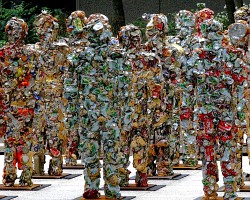
There have been a few interesting art projects discussed on How Can I Recycle This? recently, that I thought were worth pointing out. The first is HA Schult's Trash People. Schult installs an army of 1000 humanoid figures composed of garbage in various locations around
the world in a stunning display that connects us to our waste and shows us that we are what we throw away. It's thought provoking and potential nightmare fodder for those with overactive imaginations (think of that army coming to life and trying to throw you away). The scale of these displays is amazing--follow the link to Schult's site from the How Can I Recycle This? blog and check out the photos. When you see masses of trash people lined up on the Great Wall of China or in front of Egyptian pyramids, it's hard to not get the message that we waste too much in our society and to begin to understand that wastefulness has an effect not only on resources, but on people as well. (Photo featured here is an image shown on How Can I Recycle This? and attributed to dbking on Flickr)
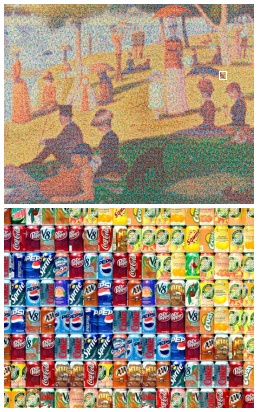
Just last week, Ho
w Can I Recycle This? featured the artwork of Chris Jordan, in particular an exhibition called Running the Numbers. This in another great visual aid to convey the scale of our wastefulness (along with other non-environmental social issues, as not every work in this exhibition deals with trash). Jordan presents striking images along with statistics that shock the system. Cans Seurat, his recreation of a famous Seurat painting using aluminum cans, for example, lets the viewer know that it was composed of 106,000 cans--"the number used in the U.S. every thirty seconds." I had been aware of Jordan before, having come across his web site for a previous work called Intolerable Beauty a few years back (check it and his other exhibitions out at http://www.chrisjordan.com/). If you want to convey the scale of waste in the U.S. to someone, the photos in Intolerable Beauty will certainly help. If you check out Running the Numbers on Jordan's web site, you can also view other visual aids related to the use of plastic cups on airlines, plastic water bottles, cell phones, fuel (in the form of jet trails and SUVs), paper bags, paper cups, plastic bags, office paper, and batteries, among other items. (Photo at left is Cans Seurat as shown on How Can I Recycle This?)
If all of this hasn't made you sick yet, go to National Geographic's Human Footprint for additional depressing illustrations of our consumption. The Trash People are mentioned on that site too.
There have been a few interesting art projects discussed on How Can I Recycle This? recently, that I thought were worth pointing out. The first is HA Schult's Trash People. Schult installs an army of 1000 humanoid figures composed of garbage in various locations around
Just last week, Ho
If all of this hasn't made you sick yet, go to National Geographic's Human Footprint for additional depressing illustrations of our consumption. The Trash People are mentioned on that site too.
Subscribe to:
Posts (Atom)