Featured Post

Content being republished on Medium

Hello readers! I'm renewing my efforts to share content about reuse via this blog, but from July 2023 forward, new posts will also appea...

Showing posts with label cell phones. Show all posts

Monday, May 7, 2018

Illini Gadget Garage Encourages People to Repair Rather than Replace Devices

I'm fortunate to have a day job that aligns with my personal values and allows me to work on various projects to reduce waste and otherwise foster sustainability. Some of these projects even encourage reuse; as you might imagine, those tend to be my favorites.

One such favorite is the Illini Gadget Garage project. The Illini Gadget Garage is a collaborative repair service, offered at no cost to the public, focused on electronics and small appliances. The goals of the project are to extend the useful life of products, and thus conserve the natural and human resources invested in their manufacture; empower individuals to understand more about how their devices function and to have confidence in STEM-related skills; and to further empower people to see do-it-yourself repair as a viable option for addressing minor damage and performance issues.

Words "Illini Gadget Garage" framed by green lines that look like circuits with a solder point on one end and a leaf shape on the other

By "collaborative repair," we mean that we're here to help you help yourself! You don't drop off electronics at the Gadget Garage for someone else to repair so you can pick them up later. You come in, tell us about your problem, and together we'll sit down, do a little fiddling and Internet research, and work on getting your device back in working order. We're combating the mainstream belief that electronics are too complex or expensive to repair by welcoming and assisting individuals of all technical experience levels (including "zero," "zilch," "nada" and "none") to "tinker" with their devices. Depending on the situation, activities may range from guidance on how to make your device run faster or install new software to hands-on repair and replacement of components. We don't sell replacement parts, but we'll help you figure out if you need parts, what those are, and where you can get them. Then you can obtain those at a local shop or online and come back in when you're ready to make the replacement so we can provide guidance and moral support! Or, if you're comfortable with doing it on your own at that point, that's cool too.

By "electronic devices," we mean all the typical items this phrase brings to mind, such as laptops, smartphones, tablets, etc., AND other small appliances and common household devices with electronic components. Stop and think about it for a minute–we're surrounded by items with electronics integrated into them. Even greeting cards can have sound cards inside them to play music or record messages. We believe all items with electronic components should last, and not be seen as disposable. We can't guarantee that we can show you how to fix everything you bring in, but if you can carry it in and it has an electronic component, we'll definitely give it a try! And hopefully, we'll have fun together doing it. If the required repair or maintenance seems beyond our capability, we'll help you find local repair shops that can help. (Note that we do not make endorsements or specific recommendations–we just help you help yourself. The decision about which, if any, local repair business to take your device to is ultimately yours alone.) If your device is sadly beyond repair, we'll help you find local recycling options.

You can check out our impacts at http://publish.illinois.edu/illinigadgetgarage/about/our-impact/. You can also check out a video from Urbana Public Television's "It's All About U" program, highlighting the project below. (Note the bit on the IGG starts at 8:59.)

If you're interested in volunteering or setting up an appointment to work on your device, you can contact project staff at illinigadgetgarage@gmail.com. We also have pop-ups throughout the community, so be sure to check our web site or Facebook page for announcements. On May 19th, we'll be at the Champaign Public Library, giving a presentation/demo on how to clean your gadgets (you'd be surprised how often a good cleaning fixes performance issues!), so look for presentation details soon on Facebook.

One final bit of shamelessness: if you think this sort of demystification of technology and promotion of a "repair rather replacement" culture is worthwhile, please consider making a small donation to help support continued programming--see http://publish.illinois.edu/illinigadgetgarage/donate/donation-form/ for details. Thanks in advance for your consideration!

Tuesday, February 9, 2010

Electronic Trash to Treasure

I have the privilege of being involved with some really cool projects as part of my day job. If you are creatively and/or technically inclined, consider entering the International E-Waste Design Competition. This contest is open to anyone 18 years old or older who is currently attending college or has graduated since May 2006. You can enter as an individual or as a team. The idea is to take e-waste that would normally end up in landfills and create something new, useful and appealing from it. There are two categories in which you may enter--"Designer/Artist" for projects more focused on the aesthetic, and "Technical/Geek" for projects that result in cool gadgets from electronic components. See the competition web site for full details. The entry deadline is April 1, 2010, and there are some serious prizes involved, as well as the opportunity to impress a jury of industry leaders. Registration is free and currently open, so put your thinking cap on and consider how the dearth of electronic waste that our culture creates every year could be turned into a valuable resource instead of an environmental burden.

Tuesday, March 17, 2009

University of Illinois Sustainable e-Waste Design Competition

Kudos to University of Illinois at Urbana-Champaign (UIUC) professor William Bullock, for offering a two-semester course sequence that examines the problem of electronic waste. In Fall 2008, students in the sequence studied all aspects of the e-waste problem and produced a collaborative report on their findings. This semester, students are focusing on sustainable product design, and will be participating in a competition to produce new or recycled products from discarded electronic components. The competition is actually open to all UIUC students, not only those enrolled in Bullock's course. Materials for use in the competition were collected on campus in February from local citizens. Also, students participating in the competition were encouraged to donate an old computer as an entry "fee."

Registration for the competition is currently closed, and the competition itself will take place in April. The finalists and winner will be displayed on the competition web site, www.ewaste.illinois.edu. Any leftover e-waste not used by participants will be responsibly recycled by PC Rebuilders and Recyclers in Chicago, an organization that refurbishes donated computer equipment and sells the results at reasonable prices to schools, non-profits and individuals that might not otherwise be able to access such equipment. They recycle any components that are unusable.

To read more about the competition, visit the competition web site listed above or see the competition flyer. Criteria for judging of entries is available here.

Tuesday, July 22, 2008

Thought Provoking Art: HA Schult and Chris Jordan

If you've never visited How Can I Recycle This?, a web site produced in the UK focusing on ideas for recycling and reusing virtually any material, take a moment to check it out. If you have a material that you want to find a use for, you can send the suggestion to them to discuss and open up for comments from other readers. My one complaint about this inspirational site is that you can't browse by category anywhere except on the archives page, and even there, the topics listed don't seem to include all of the categories into which posts are placed. That's a personal thing--I like to see the categories that are available because I might not think to search by a particular phrase.

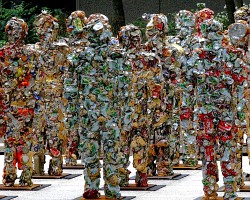
There have been a few interesting art projects discussed on How Can I Recycle This? recently, that I thought were worth pointing out. The first is HA Schult's Trash People. Schult installs an army of 1000 humanoid figures composed of garbage in various locations around the world in a stunning display that connects us to our waste and shows us that we are what we throw away. It's thought provoking and potential nightmare fodder for those with overactive imaginations (think of that army coming to life and trying to throw you away). The scale of these displays is amazing--follow the link to Schult's site from the How Can I Recycle This? blog and check out the photos. When you see masses of trash people lined up on the Great Wall of China or in front of Egyptian pyramids, it's hard to not get the message that we waste too much in our society and to begin to understand that wastefulness has an effect not only on resources, but on people as well. (Photo featured here is an image shown on How Can I Recycle This? and attributed to dbking on Flickr)

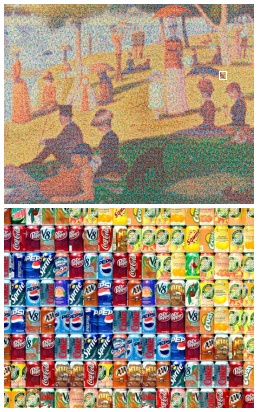
Just last week, How Can I Recycle This? featured the artwork of Chris Jordan, in particular an exhibition called Running the Numbers. This in another great visual aid to convey the scale of our wastefulness (along with other non-environmental social issues, as not every work in this exhibition deals with trash). Jordan presents striking images along with statistics that shock the system. Cans Seurat, his recreation of a famous Seurat painting using aluminum cans, for example, lets the viewer know that it was composed of 106,000 cans--"the number used in the U.S. every thirty seconds." I had been aware of Jordan before, having come across his web site for a previous work called Intolerable Beauty a few years back (check it and his other exhibitions out at http://www.chrisjordan.com/). If you want to convey the scale of waste in the U.S. to someone, the photos in Intolerable Beauty will certainly help. If you check out Running the Numbers on Jordan's web site, you can also view other visual aids related to the use of plastic cups on airlines, plastic water bottles, cell phones, fuel (in the form of jet trails and SUVs), paper bags, paper cups, plastic bags, office paper, and batteries, among other items. (Photo at left is Cans Seurat as shown on How Can I Recycle This?)

If all of this hasn't made you sick yet, go to National Geographic's Human Footprint for additional depressing illustrations of our consumption. The Trash People are mentioned on that site too.